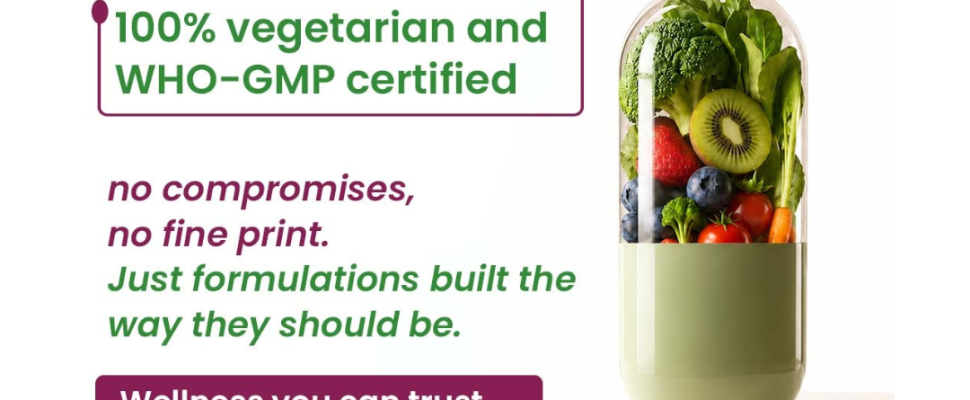
In today’s health-conscious world, consumers are paying closer attention to what they consume and how products are made. Beyond nutritional benefits, people increasingly want transparency, quality, and products that align with their dietary preferences and values. This shift has brought vegetarian nutraceuticals into the spotlight. However, being labelled “100% vegetarian” is about more than simply avoiding animal-derived ingredients. It reflects a broader commitment to ingredient transparency, responsible formulation, quality assurance, and consumer trust.
Nutraceuticals are products derived from food sources that provide nutritional or health-related benefits beyond basic nutrition. They include dietary supplements, vitamins, minerals, herbal extracts, amino acids, and other specialized nutritional formulations.
Vegetarian nutraceuticals are designed to meet nutritional needs without relying on ingredients derived from animals. Depending on the formulation, these products may contain plant-based extracts, vitamins, minerals, and other suitable ingredients. They are available in different forms, including tablets, capsules, powders, and liquids.
For consumers following vegetarian diets, choosing these products can be an important consideration. However, the distinction between a product that appears vegetarian and one that has been carefully formulated to meet vegetarian requirements lies in the details of its ingredients, manufacturing processes, and quality controls.
One of the most significant aspects of vegetarian nutraceuticals is ingredient transparency. Not every ingredient in a supplement is immediately recognizable to consumers, and some may have animal-derived origins.
For example, gelatin capsules are commonly produced using animal-derived materials. Certain other ingredients, including specific forms of fatty acids, enzymes, and processing aids, may also have animal origins. The source of an ingredient can vary depending on the manufacturer and formulation.
A genuine commitment to vegetarian nutraceuticals requires careful evaluation of ingredient sources and suitable alternatives wherever necessary. Plant-based capsule materials, such as hydroxypropyl methylcellulose (HPMC), may provide alternatives to conventional gelatin capsules.
Clear labelling and accessible product information help consumers make informed decisions. When manufacturers communicate openly about ingredients and their origins, they can build stronger relationships with customers who value transparency.
A vegetarian label alone does not guarantee that a nutraceutical is safe, effective, or of superior quality. These qualities depend on several factors, including ingredient purity, formulation accuracy, manufacturing standards, and appropriate quality testing.
Responsible manufacturers establish quality-control procedures to verify the identity and specifications of raw materials. They also monitor manufacturing processes and test finished products according to relevant requirements.
Depending on the product, testing may evaluate ingredient potency, microbial contamination, heavy metals, and other potential contaminants. Proper storage conditions and packaging also play important roles in maintaining product quality throughout its shelf life.
Therefore, consumers and businesses should look beyond a single label claim. A trustworthy vegetarian nutraceutical should combine suitable ingredient sourcing with consistent manufacturing practices and evidence of quality assurance.
Dietary preferences are often connected to personal values, cultural practices, and lifestyle choices. For many consumers, vegetarian products provide greater confidence that their nutritional choices align with their dietary commitments.
As awareness of ingredient origins grows, consumers increasingly expect supplement manufacturers to consider these preferences throughout product development. This creates opportunities for brands to develop formulations that address specific dietary requirements without compromising appropriate quality standards.
Vegetarian nutraceuticals can also appeal to consumers seeking plant-based alternatives, although vegetarian and vegan are not interchangeable terms. Vegetarian products may contain certain animal-derived ingredients, such as dairy-based components, while vegan products exclude animal-derived ingredients more broadly.
Clear definitions and accurate labelling help prevent confusion and enable consumers to select products that suit their individual requirements.
The growing demand for vegetarian nutraceuticals is encouraging manufacturers to explore alternative ingredients, capsule technologies, and formulation approaches.
Plant-derived ingredients, fermentation-based production methods, and carefully selected non-animal alternatives can offer potential solutions for developing suitable products. For example, certain vitamins and other nutritional ingredients can be produced through fermentation or synthesized without relying on animal-derived sources.
However, ingredient suitability depends on the specific nutrient, its source, manufacturing method, stability, and intended use. A plant-derived ingredient is not automatically more effective or safer than an alternative from another source.
The objective should be to develop formulations that meet consumer preferences while maintaining appropriate standards for quality, stability, nutritional value, and product performance.
Delivering a genuinely vegetarian nutraceutical requires attention throughout the supply chain. Manufacturers must understand the origins of raw materials, assess suppliers, and establish procedures to reduce the risk of unintended contamination or ingredient mix-ups.
Appropriate segregation, cleaning procedures, documentation, and traceability can support the integrity of vegetarian formulations. Where relevant, recognized certification schemes and independent verification may provide additional assurance, provided their scope and requirements are clearly understood.
Businesses should also ensure that their claims are accurate and supported by appropriate documentation. Misleading or exaggerated statements can undermine consumer confidence and damage brand credibility.
For nutraceutical manufacturers, vegetarian formulation should therefore be treated as an integral part of product quality management rather than merely a marketing strategy.
Consumers can take several practical steps when selecting vegetarian nutraceuticals:
These steps help consumers distinguish between a simple label claim and a product supported by meaningful quality practices.
The real value of vegetarian nutraceuticals lies in the principles behind the product. Ingredient transparency, responsible sourcing, consistent manufacturing, appropriate testing, and honest communication all contribute to consumer confidence.
As the nutraceutical industry evolves, manufacturers have an opportunity to build products that respond to changing dietary preferences while maintaining rigorous quality standards. For consumers, understanding what lies behind a vegetarian claim makes it easier to evaluate products and make informed decisions.
Ultimately, 100% vegetarian nutraceuticals should represent more than a dietary category. They should reflect a thoughtful approach to formulation, quality, transparency, and trust. When these principles guide product development, a label becomes more than a promise—it becomes part of a broader commitment to responsible nutrition.